Tuesday, November 7, 2017

COP 23 Day 2

Mariah and Ari:
We started our day by attending a press conference by Climate Action Network International in the Bula Zone. While there were three panelists, the press found the speaker from China most interesting and asked him most of the questions. This speaker opened by explaining that Trump’s presidency and the US pulling out from the Paris Agreement was an opportunity for China as it allows China to take on a leadership role in regards to action on climate change. The speaker said that China was already doing this—China has begun to phase out coal fired power plants and has increased its participation in climate diplomacy. He also raised the point that China does have continued room for improvement with regards to reporting on their progress, needing more frequent, higher quality, and broader coverage. Additionally, many of the same yardsticks of success from yesterday’s talk were repeated as things to keep an eye on throughout these two weeks.

Following this press conference, we headed over to the Bonn Zone, taking a solar-powered zero-carbon emission trolley to get there!
Another transportation option between the two zones are free bike rentals:

Mariah:
My next event of the day focused on climate change for Caribbean UKOTs (UK Overseas Territories), and was officially titled “Trouble in Paradise: Reducing vulnerability and enhancing island resilience to climate change in the Caribbean.” In the initial plan, representatives from the Caribbean and other small island (SIDS - Small Island Developing States) parties were supposed to lead the discussion but due to a scheduling mix up, many of them were attending other SIDS meetings. Instead, a man from the Royal Society for the Protection of Birds (RSPB) lead the conversation, providing an interesting ecological perspective. The talk touched on impacts that are already occurring as stronger storms become the new norm and about the projected physical impacts, which include a decrease in precipitation (5% by 2100), sea level rise (0.5-0.6m by 2100 in the Caribbean sea), and ocean acidification. A representative from the Fijian party spoke up from the audience at the end, sharing her experiences in an environmental NGO in Fiji and Fiji’s current progress in recovering from Cyclone Winston (2016 - Category 5, most intense on record in the Southern Hemisphere and strongest to make landfall). Discussions of resilience included mentions of the differences between soft and hard engineering, as well as concerns that there may not be enough time or data to build the needed resilience when it comes to protecting ecosystems and many endemic island species.

Later in the afternoon, I attended a second session, “Coordinated Action on Sustainable Development.”  I chose the talk partially because two individuals from Nepal were speaking on the panel (a representative from the government and one from ICIMOD (International Centre for Integrated Mountain Development)), but there were also representatives from IASS (Institute for Advanced Sustainability Studies), PaCE-SD (Pacific Centre for Environmental and Sustainable Development), and a country representative from the Solomon Islands. The talk itself was quite interesting and I feel like I got a well-rounded look at a number of different stakeholder perspectives of the intersection between climate change and sustainable development. One of the most thought-provoking components of the talk was simply the choice of countries (Nepal, Solomon Islands/the other Pacific islands) and its significance within broader contexts at the conference. While SIDS have their own regional designation at the conference, there was apparently a recent report that also linked these high mountain and island communities in conversations about climate change impacts. This may be done partially because both areas are already seeing the negative impacts of climate change on their communities in a more direct and significant way than some other regions, but the correlation may also erase some of their unique challenges and opportunities.

Ultimately the talk was very positive about the actions that are being taken at NGO, community, and governmental levels in the respective areas; I found this to be reassuring but I also know that there is so much that still needs to be done, in Nepal and around the world, and that I need to not be lulled into a false sense of security about the severity of these issues.

Ari:
At lunchtime, I met Bernard, one of the heads of sustainability for Porsche, Germany. He told me that this was not one of his first COPs by any means, and he was here as an observer and would be speaking on a panel later this week.

Following my conversation with Bernard, I headed to the German Pavilion for a talk on the role of cities in addressing climate change. The head of the German Advisory Council on Global Change (WBGU) said that cities are responsible for a large percent of CO2 emissions and if we want to decrease atmospheric CO2, we have to change our cities. She highlighted the fact that there are many sector specific solutions for climate change in cities, but there is no overall view, particularly in respect to urban local governance. For urban transformation, the head of WBGU said that we must sustain natural systems (keeping them in harmony both globally and locally), promote eigneart (which roughly translates to people-oriented, diversity of cities), and finally to ensure inclusion through making political participation and economics accessible to the citizens). In addition, we must enable city governments to decide their local affairs and establish collaborative governance structures across cities and countries.

After this session, I attended a panel on lands, oceans, and water-food-ecosystem resilience in the mid-latitude region. This talk involved discussions of traditional knowledge in agriculture, farmer-managed natural regeneration, and supporting indigenous voices both financially and otherwise. The final panelist said that the Paris Accord left indigenous people feeling furious. The loss and damage these people have incurred from natural disasters cannot always be monetarily quantified. Moreover, climate finance is not currently reaching those who are most vulnerable to climate change.

Thus far I have really noticed the intentional integration of indigenous voices at this conference, at least on the Bonn Zone side. However, it feels that there are two main categories of countries who have been participating on these panels and those are the most wealthy countries and the most destitute. There seems to be little space for those countries that fall into the middle sector of wealth, and I am eager to hear from them.

Ellie:
My first day at COP23 was filled mostly with sessions given by civil society actors in the Bonn Zone, however, I was interested to see if this group’s aspirations translated into the diplomatic process, and spent all of day two in the Bula Zone.

First I attended the third plenary session of the APA (Ad Hoc Working Group for the Paris Climate Agreement). The meeting opened with an opportunity for civil society leaders to voice their opinions on motions discussed during previous negotiation sessions. These leaders represent large umbrella coalitions, formed around issues such as women and gender, trade unions, and the private sector.

Then, I watched a press conference by WWF on the options for accelerating the Paris Initiatives during the COP23. It provided an update on various country positions, as well as important trends to watch for at this conference. One of the more interesting things discussed was the difficulty in fulfilling the funding goals necessary for implementation. A speaker on the panel said that the struggle to gather funding pledges from developed countries was beginning to erode the fragile trust between countries achieved in Paris.

I then sat at the Conference of the Parties (COP) Plenary. The meeting began with a word from the Palestine delegation. The speaker stated the importance of equal implementation of the Paris accords, which requires each country to follow through on their NDC’s. The COP president, Prime Minister Frank Bainimarama of Fiji, then guided the meeting through agenda items two and ten. Agenda item two was titled Organization of Work, and addressed the future leaders and hosts of COP conferences. Agenda item ten was titled Climate Finance, and featured reports given by both the Green Climate Fund and the Global Environment Facility. During both agenda tasks, brief statements were heard by country leaders and civil society. These positions will be further negotiated at smaller meetings.
 
Finally, the Conference of the Parties of the Paris Agreement (CMP) met for a plenary towards the end of the day. The agenda item being discussed addressed the structuring of dialogue during Fiji’s COP. Leaders from COP22 reported on the ways in which they integrated outside opinions during their COP, followed by a report on the current forums open for discussion at COP23. Speakers from both the Maldives and Iran stressed the need to have open and inclusive dialogue. The Iranian leader in particular spoke to the need for empathy and collective action while moving forward with Paris implementation.

----

We ended the day a little earlier than yesterday, returning to Cologne (Köln) with enough time to go out for dinner and walk around the cathedral!

Monday, November 6, 2017

COP 23 Day 1

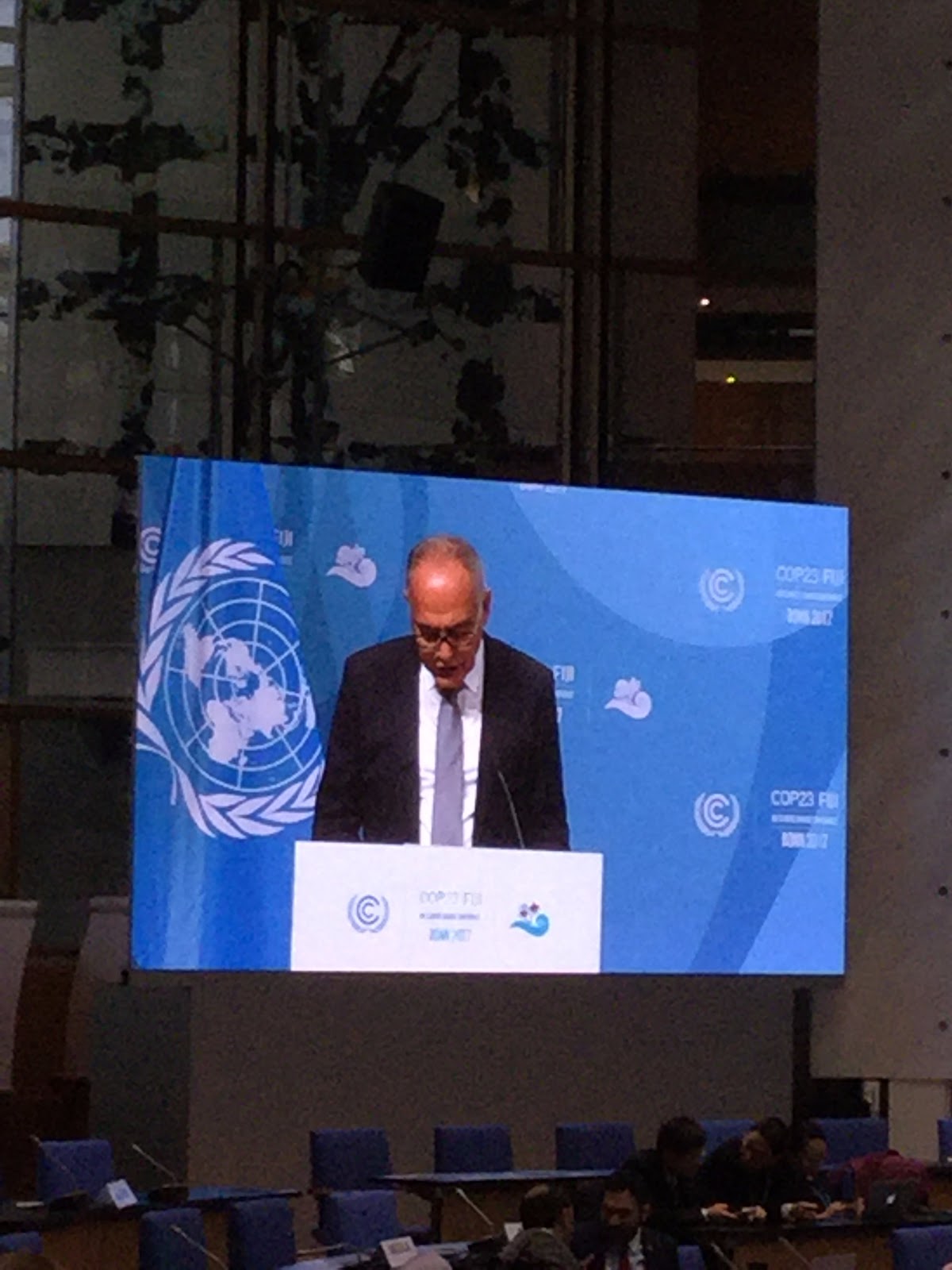
This morning, we rode the train in from Cologne to the Bonn UN campus. On our way we met a woman, Monique, from the Cameroon delegation. We walked with her from the train stop to the Bula campus, which is the diplomatic zone. The opening plenary began as the COP22 President from Marrakesh, H.E. Salaheddine Mezouar, welcomed us to Bonn. He spoke about the importance of cooperation, solidarity amongst developing nations, and a growing tradition of non-state actor participation. All seemed like viable strategy for combating the lack of leadership by the United States in global climate solutions. He then invited Frank Bainimarama, Prime Minister of Fiji, to officially accept the Presidency of COP23. As the first Pacific Island nation to host a COP, the Fijian presidency is especially notable as many of these countries are already facing the severe effects of climate change. Following his speech, a group of Fijian men performed a ceremony that included traditional song, dance, and clothing to celebrate and welcome the transition and the opening of the conference. A number of other leaders from the COP community also spoke, including Barbara Henricks of Germany. One of the main messages that we took away from this plenary was the importance of action and the implementation of the Paris Accord.
Following the plenary, we headed over to the Bonn Zone, which is to be used by both state and nonstate participants. There we each ate our own sustainable, locally sourced lunch from the cafeteria and broke apart to attend different sessions.

____

Ari:
I attended a panel session entitled, “Peasant Agroecology Feeds the People and Cools the Planet,” which was sponsored by two grassroots organizations: La Via Campesina (LVC), Secours Catholique-Caritas France (SCCF). The panel began by discussing the fact that 50% of GHG emissions can be attributed to the industrial food system, which suggests that there is much work to be done in this complex sector. The four panelists, who were peasants from Puerto Rico, Indonesia, France, and Mali all argued that a food system based on peasant agroecology and food sovereignted will help cool the planet. In addition, they all agreed that the current industrial food system has been colonialist, corrupt, and militarized. The root of the climate injustices faced by these peasants is a result of US and European consumption and capitalism. Agroecology, on the other hand, is a social movement based on traditional knowledge with the aims to empower farmers and fishers as well as aid in creating climate justice for communities impacted by these Big Ag corporations.

The panelists said that while these conversations are happening in local communities around the world, it is of the utmost importance that they are also happening in these types of international settings, particularly in the UN. But the panelists also had harsh criticisms of international decision making, stating that the Paris Climate Agreement relies on the commodification of nature and is ultimately non-binding. Overall, I found this panel absolutely fascinating. It was amazing to see grassroots organizers on an international platform, speaking with such passion. In addition, I was surprised that there was such strong criticism of the Paris accords in a UN sponsored event, but also found this reassuring as it shows that the UNFCC is really trying to bring in different voices and perspectives on climate change. And now, I find myself extremely interested in learning more about agroecology.

Ellie and Ari:
We attended a panel by the Global Ecovillage Network (GEN), which is a world network of communities looking to build intentional, sustainable lifestyles. The speakers represented each region of the world, and described the various ways ecovillages address a diverse range of local issues. One aspect we found particularly interesting was the potential to rebuild areas destroyed by climate crises using this sustainable model. One of the panelists said that if just 5% of Europeans lived an ecovillage lifestyle, Europe would meet 80% of its Paris 2020 goals. This is quite a notable statistic, and we are both curious to learn more about ecovillages, particularly those in the US. In closing, the panelists also stressed that they are trying to bridge ecovillages with urban areas, which would make them more accessible. This is also relevant in the context of the US, and we are interested in learning progress in creating urban ecovillages in the US.

Ellie:
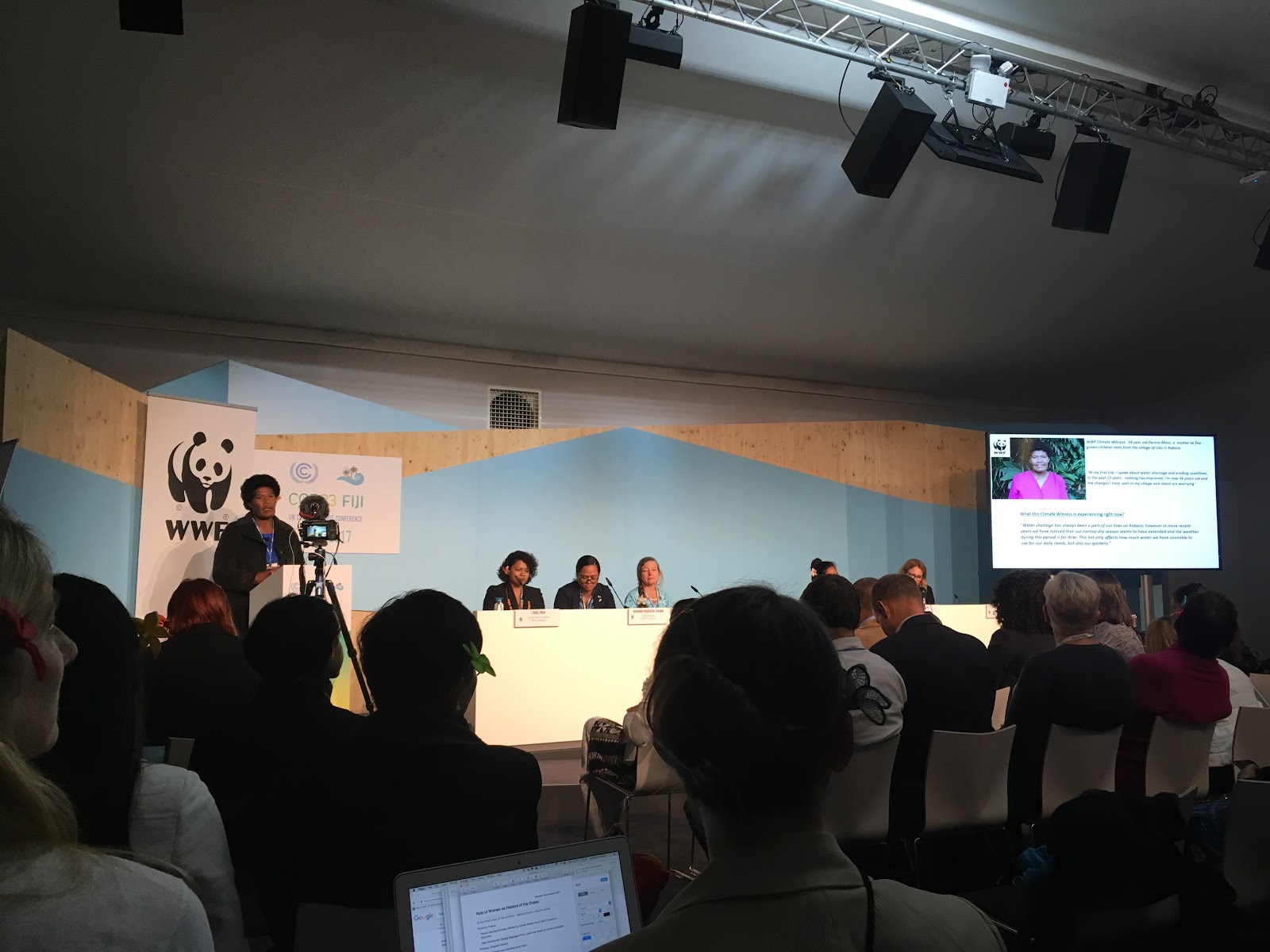
The second session I attended was titled The Role of Women as Guardians of the Ocean, and was sponsored by WWF. A panel made mostly of leading women from Fiji spoke to the importance of gender equality during the development of climate protection strategies. Within the Fijian island communities, women often occupy the base of traditional knowledge and cultural education. The personal narratives shared also spoke to the urgency that the Pacific islanders feel over the issue of climate change, for while technology may mitigate rising sea levels, development cannot fix the loss of a home.


Mariah:
The first session I attended was put on by the Climate Action Network (a network of over 850 environmental NGOs) entitled “Yardsticks for Success at COP23” to get an overview about some of the things to be aware of in the negotiations that will happen for the next two weeks. Speakers from a number of countries including NGO leaders from France & Fiji and Ambassadors from Fiji & Morocco spoke, each bringing their own perspectives to the issues at hand. As this is the second COP since the Paris Climate Agreement, there was continued emphasis on how creating specific goals and setting plans into motion before upcoming reviews (like the five-year Global Stocktake in 2023). Equally emphasized were the importance of finances, support for communities already facing the effects of climate change, and continued recognition of non-state actors as key players in the conversation:
  • Financial matters, including:
    • Clear financial support from developed countries (for their commitment of $100 billion)
    • Transparency in accounting
  • Support for frontline communities, including through:
    • Enhanced climate adaptation (the Adaptation Fund -- ensure financial sustainability and articulate its functions)
    • Loss & Damage
  • Non-state actors:
    • Empower the most marginalized by adopting a gender action plan and elevating indigenous voices
    • Workshops between party and non-party actors
    • Public participation in the decision making

The second session I attended was titled “Imagine our world with +4 degrees celsius: Coping with the impacts of climate change on freshwater, oceans and cities.” The Paris Climate Agreement set forth a goal of no more than a 1.5 (or maximum 2) degree celsius increase over global pre-industrial levels. However, our current track puts us much closer to a 4 degree increase and this talk provided a number of different perspectives of how this will play out, focusing on water systems around the world. It is definitely a sobering topic and one of the key messages I took away from this talk was just how interconnected all of these issues are. A representative from the Nordic Cooperation (Denmark, Norway, Sweden, Iceland, and Finland) pointed out how, while all five countries are doing well on reaching the Sustainable Development Goal #6 (Clean Water & Sanitation), they need to also take into consideration how other aspects like consumption and production are linked. Another panel speaker, focusing on the case study of the Mediterranean, noted that high temperatures mean not only sea level rise, heat waves, and extreme weather events (devastating in and of itself), but also will lead to more fires, changing ecosystems, loss of soil, and decreased agricultural yields (and more).

---

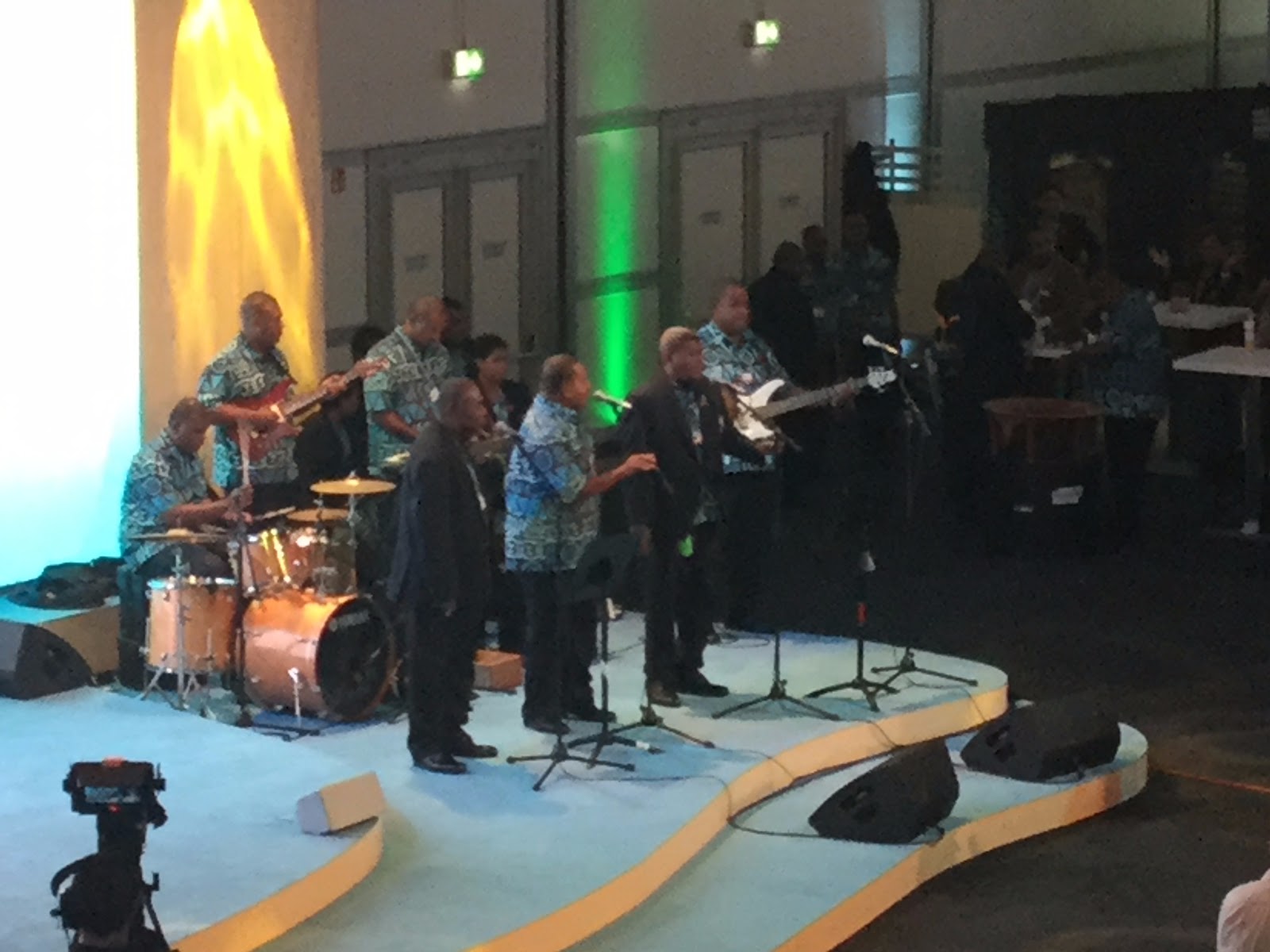
We closed out our day at the Evening Reception, which included delicious snacks, drinks, and lively performances from the Fijian Police Band. Recognizing a “No DAPL” t-shirt, we approached the man (Michel) wearing it and asked him whether or not he was from the upper midwest. Although Michel wasn’t (he was from Ecuador), we engaged in a lively conversation about indigenous rights. We spent most of the evening talking with Michel as well as a number of individuals from a broad coalition of indigenous peoples (including Brazil, Guatemala, and Indonesia). Each of them are active in their own fights and community groups, but they are spending four weeks touring five cities in Europe through the Weaving Ties Initiative (weavingties.org).


Friday, November 11, 2016

COP 22 Day 5


Our final day at the C20161111_165638.jpgOP was short and sweet. We took a final walk through the blue zone, ate lunch, and did some work in one of the computer rooms. We spent our finals hours exploring the green zone in more detail. We were interested specifically in projects and initiatives based in Morocco.
We walked through the displays in the civil society portion of the green zone, reading the posters of several climate and sustainable development projects that various groups were doing throughout the world. The civil society tent was rectangularly shaped, with “agoras” positioned in the middle for open discussions on various topics and rows of display booths lining the “agoras” on both sides. We took interest in displays that pertained to micro-credit financing for rural Moroccan women and climate leadership initiatives targeting youth. Finally, we met with a women from the Moroccan Ministry of Environment, who helped put us in contact with The Moroccan Agency of Development in the North and The Moroccan Agency for Solar Energy, which heads Morocco's renewable energy initiative. These contacts will be used for our respective independent study projects we will be conducting for the remainder of the semester.
Our mood throughout the week oscillated between hopeful, inspired, and melancholic. With the election of Donald Trump, we have been in despair for the future of our world’s ecosystems and the impacts that his presidency will have on the fight against climate change. Yet, attending COP22 showed that those most dedicated to climate change will not stop, regardless of the political situation throughout the world. We very much appreciated the opportunity to witness an initiative such as COP22 and its determination to make planet earth a safer and better place for all of us. We are immensely grateful for the opportunity to attend this first week of the Conference of Parties in Marrakech; we certainly learned a lot.

Thursday, November 10, 2016

COP 22 Day 4


20161110_182302.jpg

We spent Thursday exploring the green zone, which is a space for non-governmental organizations and private sector businesses to present their green initiatives. The green zone is split into two different sections, one for civil society groups and the other for private-driven innovation. Our purpose in the green zone was two-fold. First, we felt it was important to hear both governmental and non-governmental perspectives in order to be exposed to a more holistic narrative around climate change. Second, we were seeking out information relevant to our research projects.
Of particular interest, was the Noor solar project that is currently being built in the Moroccan city of Ouarzazate, just a few hours outside of Marrakech. When the plant is completed, it will be one the largest solar plant in the world. The plant is part of a public-private partnership between the Moroccan Agency for Solar Energy (MASEN) and a corporation called ASWA Power, from Saudi Arabia. The Noor solar project is part of Morocco’s larger effort to diminish its energy dependence (96% of its energy is imported), while, simultaneously, contributing to the transition to renewable energy. The project is capital intensive; the Moroccan government took out over 5 billion dollars in loans to pay for the project. The government is also talking of eventually exporting some of its renewable energy to Europe. Critics of this intention say this is a new form of colonialism: green colonialism. That is, the Moroccan government is undertaking all of the risk associated with a solar energy, a relatively costly form of energy, and allowing Europe to externalize the very risks Morocco is undertaking. The Noor solar project is nevertheless an interesting development in the realm of renewable energy. It will be fascinating to see how the project progresses.
We finished our day back in the blue zone, by attending a side event titled Climate Related Displacement and Migrants: Rights and Responsibilities After Paris. This topic interested both of us; after spending a semester study migration we were interested to hear a climate perspective to migration, which was not addressed in our thematic course. Panelists included a Minister from Bangladesh, representatives from civil society networks, and representatives from UNHCR and UNHRC.
Many voiced concerns about increasing pressures and stresses on populations in South East Asia and Sub- Saharan Africa, two regions that are are/will be most affected by climate change. Panelists cited droughts, floods, sea level rise, land grabbing, pollution, the shrinking of Lake Chad, and overgrazing resulting in desertification as major push factors of displacement. These changes have both direct and indirect consequences for these populations and those around them. Not only are people losing their homes, but they are losing their livelihoods; as people are forced to move within and even across borders, there is increasing social tension and conflict. Many of these migrants are marginalized in their host communities and are not protected under international law. Because climate migrants are not technically considered refugees (they have not faced ‘persecution’) they are excluded from any protection that this term could bring such as access to food, shelter, healthcare and education.
As one panelist said, when people are being forced to leave their homes because of climate change, it is because local coping mechanisms have failed completely and there are no other options left. These people are desperate and need to be supported, and it is unfortunate that this topic does not often come up more frequently in negotiations. Ultimately, the conference is about people; it has been common for parties to get caught up in discussions about fossil fuels and solar farms and forget about the people whose lives are truly being upended and changed forever.  This topic will only grow in importance; panelists called for the creation of a task force in coordination with organizations and governments to come up with integrated solutions to protect the people that are most vulnerable to climate change.

Wednesday, November 9, 2016

COP 22 Day 3

We woke up Wednesday morning to the news of presidential-elect Donald Trump. 
We were in disbelief; the absurdity of the results was not something that we had prepared for. Our moods darkened as we reflected on this new reality. What would this mean for our future, our loved ones, but also the future of this planet? If the two degree benchmark is going to be achieved, it is hard to believe it will come into fruition without the participation of the second largest emitter of GHG and the largest economy in the world. The United States is seen as a leader throughout the world, for better or for worse. Will other nations follow through with their pledges even if the US does not? A Trump presidency could potentially last for eight years. With Republican control of the House and Senate, and potentially the Judiciary branch, how much damage can be done in this time? Will it be irreversible? Perhaps we are playing up the importance of the United States on the world stage. I hope we are. 
We were comforted by the fact that despite this grave news, the optimistic atmosphere of the Conference remained unchanged. Ministers and climate activists continued with their business as usual. The election of one climate denying demagogue does not mean the end for the fight against climate change. These people will continue to devote themselves to the cause, with or without the United States. 
We found distraction in one of the more informative and accessible side events of the week. It was titled: “Addressing Climate Change through Land Use: Supporting Corporations or Communities? Time to choose”. This panel consisted of representatives from various organizations working in the United States, Africa, Ecuador and Paraguay. They shared stories on how REDD initiatives in their respective countries impacted indigenous peoples living in the forests. REDD is an abbreviation for reducing emissions from deforestation and forest degradation. It is estimated that deforestation and forest degradation constitute 12%-29% of all greenhouse gas emissions. By reorienting forest management, projects can be implemented that exponentially decrease the rate of deforestations, thereby cutting emission, and more trees can be planted/saved to help remove greenhouse gases from the atmosphere. The World Bank has been at the forefront of financing these projects, such as the Forest Carbon Partnership Facility. Critics, such as those on the panel, argue these programs export a neo-liberal agenda that really has no substantial impact on emissions nor the rate of deforestation. The resources and livelihood that a forest can provide is in no way comparable to that of a monoculture plantation. One panelists noted that the only thing that REDD had in common with a real forest is that they both contained trees. All the while, national governments and corporations who support these projects and enact them, disregard the presence/role of indigenous populations.
The panelists asserted REDD programs do not benefit indigenous peoples. Rather, the opposite is true. The programs violate their human rights and land rights, contribute to the appropriation of their land, and lead to forced evictions. Ultimately, REDD programs give states and carbon traders more control over indigenous people forests. The panelists argued the intentions behind REDD would be better guarded if put in the hands of the indigenous peoples, as they have lived on their respective land for centuries and they understand how live in harmony with the land instead of against it.
Here is a link to an article from The New York Times which does a nice job of summing up the potential future for US policy on climate change and perceived threats of a Donald Trump presidency on the Paris agreement. It is by no means comprehensive. The article is titled Change Ahead: Shifts on Immigration, Climate, Health and Taxes

Tuesday, November 8, 2016

COP 22 Day 2

Day two of COP22 was much more manageable than the first. We knew our way around, and arrived with a plan of all the events and panels we wanted to attend. Our day began in the Marrakesh Plenary Hall with a meeting of the parties and the president of COP. Here, delegations give statements related to the theme of the respected plenary meetings. Delegations advocate for their nation's concerns, interests, and requests that relate to the meeting's theme. The Plenary Hall is where the official negotiations and modalities are discussed. During the first week, meetings are attended by bureaucrats who discuss issues that are less politicized. The second week higher level ministers and diplomats tackle issues the lower level bureaucrats don't have authority over. It is important to keep in mind that delegates are always speaking from the position of their government, not their own personal position. 
We heard from several representatives. The first speaker we heard from was from Thailand and spoke on behalf of "The Group of 77 and China." He urged transparency, inclusiveness, access to climate finance, and urgency in putting the Paris Agreement into action. The speakers that followed included representatives from the European Union, Australia on behalf of the Umbrella Group, Switzerland on behalf of the Environmental Integrity Group, Saudi Arabia on behalf of the Gulf States, Mali on behalf of the African Group, the Democratic Republic of the Congo, and the Maldives on behalf of small island states, just to name a few. All speakers reiterated their support for the Paris Agreement and for the requests set forth by the representative from the Group of 77 and China. They called for swift implementation and action to carry out the Paris agreement, and for sufficient time to conduct negotiations concerning the nuances and technicalities of the agreement. The countries most threatened by climate change spoke of the very real impacts that climate change is having on their nations and the impact it will further have on their nations if the agreed upon 2 degree Celsius cap is not met. 
Following this introduction to the negotiations, we found our way to the US center for a talk titled How Morocco is Advancing Clean Energy and Climate Adaptation at Home, which was sponsored by USAID and the State Department. We were hoping that this talk would be relevant to our research in Morocco, as the title of the talk invoked themes of foreign funded development and clean energy. However, it soon became evident that this talk was more about showing "inspiring" videos about aid projects that the US is funding in Palestine, Lebanon, Jordan, and the speaker only had basic knowledge about USAID involvement in Morocco. This event felt like a USAID solicitation rather than an event to inform the audience about any solid climate initiatives that USAID is or will be involved with in the coming years. Perhaps it was more telling what the speaker chose not to say. 
The final event we attended was titled Traditional Indigenous Peoples Knowledge as a Viable way for Climate Change Adaptation. The purpose of the event was to give panelists, who represented their indigenous community, a platform to voice their concerns,k challenge,s and knowledge to a wider audience. The relevance and importance of indigenous people is often overlooked in mainstream debates and discussions around climate change. Some voiced anger about western involvement in climate initiatives within their respected countries that failed to take into account the wisdom and opinions of indigenous peoples. We appreciated this perspective; so much of what we have hard at the COP so far has been from a very European and western perspective.

Monday, November 7, 2016

COP 22 Day 1

Our first day at the Conference of Parties in Marrakech, Morocco was exciting, yet overwhelming. Neither of us knew what to expect. It was our first time attending an official UN event. We arrived to the COP22 village, which sits next to the Marrakech royal palace, around 9:30 in the morning. As we arrived, zero emission buses dropped off attendees, who then piled into the main entrance to receive their accreditations. It is expected that over 30,000 people will attend the conference over the course of  the next two weeks. People arrived in a rather cheerful manner, despite the overcast skies and rainfall. We went passed through security, claimed our accreditations, and set off to see what COP events were all about.
Our first hours were spent familiarizing ourselves with the layout of the village. The COP village is a long rectangular complex, with tents on both sides that house large meeting rooms and pavilions. In the pavilions countries present their green initiatives, as well as host themed panels. We walked through the long line of tents, collecting schedules of events from the Nordic Group, Morocco, the United States, South Korea, and the European Union. These schedules detailed panels that would be held throughout the next 12 days, touching on a wide range of subjects particular to the agendas of each delegation. Furthermore, some pavilions we visited had exciting graphics, flashing lights, and videos. We got the impression that each country was trying to show-off all that it was doing in the fight against climate change, for better or for worse. Bluezone.jpg
In the afternoon, we attended a “side event” in the blue zone, hosted by Tunisia, called Market Mechanisms under the Paris Agreement - the Role of Article 6. There speakers were from Germany, Ethiopia, and Tunisia. Admittedly, some of what they said went entirely over our heads. They panelists spoke in acronyms and used technical language from the Paris Agreements that we were not well prepared to understand. Yet, the general content of the panel included a discussion on the steps that need to be taken in the effort to bolster the role of carbon markets in the transition from fossil fuels to renewable energy, and the specific ways the respective countries understood the importance of carbon markets within their national context. 
The UNFCCC is deeming this year's conference as the COP of action. Although a diverse range of topics will be covered at COP, the priority will be to “act” in order to nuance the generalities set-forth in the Paris agreement, such as specifics around financial support and nationally determined contributions (NDC). Moreover, COP22 presents an important opportunity for the African continent to make its need and concerns heard. Delegations from the African continent will focus on attaining funds for renewable energy projects and modes of technology transfers. COP22 is opportune for “developing” countries to assert their needs.
The bottomline is the reductions in CO2 emissions pledges in the Paris agreement are not satisfactory to meet the 2 degree celsius threshold. According to a UN Environmental Emissions Gap report, the current pledges under the Paris agreement, if achieved, will still result in a 2.9 - 3.4 C temperature rise by the end of century. Moreover, it is estimated that around 1.3 trillion dollars per year until 2050 will need to be invested in order to achieve 1.5-2.0 degree temperature increase (Source: Towards a Workable and Effective Climate Regime, CEPR Press). Hopefully this reality is addressed and acknowledged by delegations and high officials in this years COP.   
Disclaimer: neither of us have ever been to a conference such as this, nor are we environmental studies majors. The reason we have found ourselves in attendance of the first week of COP22 is good timing and Macalester’s status as an observing institution at UN events. This fall semester we have been studying abroad in Rabat, Morocco. We are participants in SIT’s program Morocco: Migration and Transnational Identity. The last month of our program is designated for an Independent Study Project in which we have the month of November to conduct research on a topic of our choosing; we are lucky enough to be able to attend COP22 in order to inform our projects, as well as to introduce ourselves to environmental studies and climate negotiations. We are attending COP without a fine-tuned agenda, and have chosen to attend talks about topics of interest to us and of relevance to our research.
Katelyn Miller ‘18
Kaleb Mazurek ‘18

COP 24 Day 1 -Que Nguyen

Monday, December 10: Que Nguyen '19 Events that I attended (day 1): At this COP, I hope to learn more about climate justice and ...